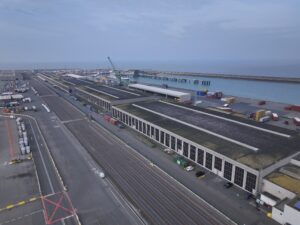
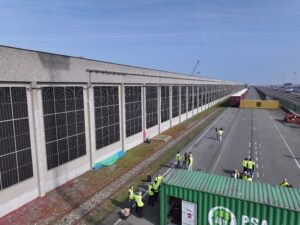
This solar energy installation is one of the largest vertical installations of solar panels in Belgium and the total annual solar power generated equals 770 MWh, enough to cover half of the entire terminal’s electricity consumption. Overall, this installation saves 101.43 tons CO2, which is equivalent to the annual CO2 emission of 220 Belgian households.
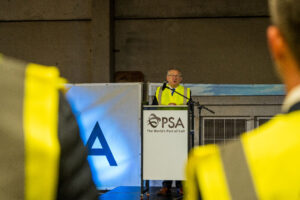
The Mayor of Bruges, Dirk De fauw, who was present at the opening ceremony, commented, “This installation shows how companies in our region are pioneering sustainable solutions. PSA Zeebrugge proves that innovation and climate ambition go hand in hand.”
“I am delighted that we are achieving our climate targets for our terminal in Zeebrugge in a creative and highly efficient way,” said Dennis Verbeeck, General Manager, Multi-purpose division of PSA Belgium. “Vertical solar panels are not common in Flanders, but we made it work as our terminal’s roof is unable to support the weight of regular solar panels.”
“While we already buy 100% renewable electricity, we are investing significantly to meet the Flemish government’s CO2 emission-reduction requirements, while contributing to PSA International’s broader ambition to achieve net zero carbon emissions from its own operations and energy use by 2050,” explained Francis De Ruytter, Regional Head Sustainability PSA Europe, Mediterranean, and the Americas. “The Flemish government requires companies with an electricity consumption of more than 1 Gigawatt-hour per year to obtain part of that energy from solar panels. With this installation, we are meeting our photovoltaic obligations for the terminal in Zeebrugge, but also for our head office in Antwerp.”
Stijn Cuppens, CEO of Insaver, added, “By installing solar panels on its site, PSA doesn’t just reduce energy costs, it also contributes to the further decarbonisation of the electrical grid. At Insaver, we believe in tailor-made solutions, tailored to the specific needs and challenges of each customer. Together with PSA, we have developed an innovative approach that perfectly matches the unique context of their terminal. We are extremely proud to have been able to realize this exceptional installation and to be responsible for its maintenance and performance as a long-term partner.”
For the Luminus Group, the PSA project represents an important step in the rollout of its “Electrify2030” program, which focuses on the electrification of the economy and society, the only way to reduce CO2 emissions and strengthen Europe’s energy independence.
Grégoire Dallemagne, CEO of Luminus Group, said, “To increase Europe’s energy independence, ensure the competitiveness of our companies, and reduce our CO2 emissions, we must focus on the electrification of our economy and society. At Luminus, we have made this our raison d’être: building a CO2-neutral energy future with electricity and innovative solutions and services. In this way, we contribute to the preservation of the planet, the well-being of people, and economic progress.”
Building a net zero carbon future
PSA is exploring further steps to source 100% of the electricity required by the Zeebrugge terminal from locally produced renewable energy. PSA Belgium’s overall objective is to halve its 2019 CO2-emission levels by 2030 and achieve net zero carbon emissions for its own activities and energy use by 2050.
To reduce dependence on gas faster and accelerate the rollout of renewable energy, Flanders requires companies to install solar panels on a minimum proportion of their roof area. According to Energy Minister Zuhal Demir, a large potential remains untapped on the roofs of Flemish buildings today and for companies themselves, solar energy is a profitable investment.
Who falls within the scope of the obligation?
- Large electricity consumers that use 1,000 megawatt hours or more of electricity from the grid on an annual basis from 2021 (around 2,500 customers from various sectors).
- For public organisations , the purchase threshold is lower, at 250 MWh from 2021 and 100 MWh from 2026.
The obligation to invest is imposed on the owners, lessee or long-lease tenants of the buildings connected to the off-take points. These are not necessarily the customers at the off-take point.
How many solar panels must be installed?
The basic requirement will be phased in:
- From 30 July 2025: minimum of 12.5 Wp per m² of roof area
- From 1 January 2030: minimum of 18.75 Wp per m² of roof area
- From 1 January 2035: minimum 25 of Wp per m² of roof area
A reduced obligation is subject to the following conditions:
- Power may be limited to 35% of annual consumption: for example, only 389 kWp must be installed per GWh of annual consumption by mid-2025.
Important: If this power limitation is implemented and annual consumption increases, additional panels may have to be installed. - When a grid study by the grid operator limits the maximum connectable injection capacity , the number of solar panels may be limited to a ratio of 0.7 kVA/kWp (around 1.429 kWp/kVA).
- For roof surfaces that are more than 25% translucent (such as sun rooms), only the non-translucent surface area will apply.
Investments can also be made in wind projects or bio-CHP that generate an equivalent amount of electricity.
What happens if you fail to meet the obligation?
The system must be put into operation before the above deadlines. If not, a fine of up to €400 per 2.3 solar panels will follow every two years as long as the obligation is not met. However, the amount of this fine is yet to be confirmed by the government.
For now, for a 10,000 m² site (normally a minimum of around 291 solar panels* to be installed from 30 July 2025), this would amount to a fine of €50,000, payable every two years for as long as the obligation is not met.
Where can the solar panels be installed?
1. Own site
The solar panels may be installed on buildings, marginal land, carports or bicycle sheds on the same site. Floatingsolar panels are also allowed.
2. Multiple own sites
For companies that have several sites of their own, it is possible to install the solar panels on one of the other sites in the Flemish Region. The above options also apply in this case.
3. Through participation
Another possibility is to contribute financially to a PV project located in the Flemish Region and put into operation after 1 January 2023.
The participant’s minimum contribution is determined based on the peak power allocated through a participation agreement:
- 800 euros per kWp obligation for participation agreements entered into before 1 July 2025
- 750 euros per kWp obligation for participation agreements entered into between 1 July 2025 and 1 January 2030
- 700 euros per kWp obligation for participation agreements entered into after 1 January 2030
For each participation, the owner will have to submit a participation agreement with a unique number to VEKA. Peak power can only be used once to meet the obligation.
Source: Solar Magazine, PV-Flanders
Manual and simulator
You can find all information on the obligation in the manual (version 20 December 2023).
This simulator (version 27 March 2023) allows you to calculate the peak solar power you need to employ and by when. The simulator also shows alternative ways to meet the obligation.
Full details of the obligation can be found at Vlaanderen.be .
Solar energy for your business: a smart choice
Investing in solar energy is not only worthwhile to meet the legal obligations, but beneficial in other ways:
- You save on energy costs and become less dependent on price fluctuations in the electricity market
- You enjoy a nice return on investment
- You make an environmentally friendly choice
1. Solar panels are cost-effective
With an average payback period starting at seven years and a 25-year production guarantee, you enjoy 18 years of worry-free pure profit. By investing in solar panels, you save immediately on your energy bills. Not only that, but the current generation of solar panels lasts up to 30 years!
2. The price of solar panels is becoming more affordable
The price of solar panels today is a lot lower than ten years ago: you pay €1.26 per watt peak on average. Even without solar subsidies, it is a viable and extremely lucrative investment. Moreover, solar panel returns are still very high, thanks in part to excellent support measures for solar panels for companies and the self-employed.
3. Solar panel efficiency continues to pay off
Because regulations have changed several times in recent years and solar panel subsidies are being phased out, some people question whether solar panels are worth installing. But rest assured, a solar panel system is still a smart investment: when investing in solar panels, you can expect a 14% return on average. There are few savings or investment options that offer returns as high as solar panels. On top of that, the production guarantee guarantees efficiency up to 80% for up to 25 years after installation!
4. Energy savings from day one
From the very first day that you start up your PV system, your energy bill will drop. After all, you are now producing your own green energy. Even the solar energy you don’t use right away will still earn you something: with a feed-in contract, your company will be compensated for every kWh of solar power it returns to the grid.
5. You protect yourself from rising electricity prices
By installing solar panels on your company’s roof, you stabilise all or part of your energy costs. This gives you more long-term security, because no matter how much energy prices fluctuate, solar panels ensure that your company has free energy to cover all or part of its consumption. And for the energy you produce, you pay no contributions, no distribution charges to grid operators and no taxes to the government.
6. You earn even on less sunny days
Solar panels do not need heat to produce electricity. Sunlight is enough. As a result, they also generate energy during winter and on less sunny days. Belgium has an average of 1,600 to 1,700 hours of sunshine a year, which is more than enough to make a solar panel system worthwhile.
7. Solar panels help your business anticipate regulatory changes
In Flanders, regulations related to solar panels have changed often in recent years. The most recent and sweeping change took place in January 2021:
Until January 2021, those who installed solar panels before 2021 could enjoy the principle of a reverse counter and prosumer tariff until 15 years after installation.
But the Constitutional Court annulled that regulation. Solar panel owners with a digital meter now automatically fall under the net actual purchase system, as will anyone who has installed solar panels after 2021. With this system, you no longer pay a prosumer tariff, but distribution network charges on your gross actual purchase.
8. You benefit from solar panel subsidies
To make an investment in solar panels accessible to businesses, there are a lot of support measures in our country. Some are limited to Flanders, while others apply to the entire country, but all make the benefits of solar panels a lot cheaper.
Feed-in compensation for your overproduction
With an energy contract with feed-in compensation like MaxxFix Pro, you are compensated for the excess electricity you return to the grid. With Luminus, you’re fully covered because all our contracts include feed-in compensation. The scheme initially applied only in Flanders and Brussels, but from 2024, Walloon business owners with solar panels also receive feed-in compensation. Check all conditions and benefits here.
Investment deduction for solar panels
The government supports investments in energy-saving measures across the country with an investment deduction. This allows you to deduct part of the purchase value of your solar panels from the taxable profit of the year you purchased them. Figures and more information on the higher investment deduction can be found here.
Solar panels will become even more advantageous in 2025, when the standard investment deduction will be increased to 10%. Moreover, the self-employed, SMEs and liberal professions will be able to deduct up to 40% of their energy-saving and green investments. The current deduction for investments in research, development and patents are being revamped as the ‘technology deduction’. Inflation no longer has an impact: the one-off investment deduction is now 13.5%, increasing to 20.5% when spread over several years.
Apart from the increased investment deduction, you can also simply write off the purchase amount over a provisionally unlimited time (such as 15 to 20 years), depending on your income. Talk to your accountant for more information.
Green certificates
These vouchers for self-produced energy that you sell back to the electricity supplier or energy regulator were created to encourage the installation of renewable energy sources, such as solar panels. Since 2014, Flanders and Wallonia no longer distribute green certificates, except for solar panels installed before that year. Brussels was the only region where you could still receive the vouchers annually, although the system has been phased out there as well from 2021.
Local contributions
Some municipalities also offer their own compensation or support measures that make installing solar panels more attractive for businesses. Check with the local authorities where your business is located.
9. Solar panel maintenance is limited
Thanks to their smooth surface and regular rinsing from rain, solar panels are largely self-cleaning and require little maintenance. This way, even rainy days benefit the efficiency of your solar panels!
10. Solar panels are a sustainable business investment
The benefits of solar panels are not limited to the financial aspect, but also a way for business owners to contribute to a sustainable future. You limit your CO2 emissions, set an example for other companies and create a green corporate image. Within ten years, once the initial cost has been recovered, you no longer have fixed costs for your electricity consumption. That kind of forward-looking thinking characterises a successful business professional!
11. Solar panels create a pleasant working environment
Working for an environmentally conscious company will motivate your employees and yourself even more. Also, solar panels are not the only way to save energy within your business. For both you and your employees, considering energy consumption and preventing waste will become second nature.
12. Free charging of company cars
With the growing popularity of electric vehicles, charging commercial vehicles has become a significant cost. By producing your own sustainable energy and using it to charge cars, you save significantly on operational costs and create an environmentally conscious image for your business.