The price at the pump continues to fluctuate and mostly in one direction: up.
For many Belgians, this is no longer a temporary problem, but a structural reality. And that has consequences.
We see it every day: families and companies are starting to think differently about mobility as well as energy.
Electric becomes a logical step
Where it used to be somewhat “new” and uncertain, it is now becoming more normal.
What stands out:
- used electric cars becoming more popular
- people compare total cost rather than just purchase price
- companies are switching faster than expected
Not because we have to, but because it’s increasingly financially sound.
The real change is at home (and at work)
What is often forgotten: electric driving is not just about the car.
It also changes how you use energy.
Instead of refueling, you go charging. Usually at home or at work.
And that’s where people really start asking questions:
- when do I best charge?
- what does that actually cost per kWh?
- can it be cheaper?
Charging without thinking is often more expensive
Just plug in and go seems logical, but is not always the smartest choice.
We see in practice that there is a lot of difference between:
- loading at the right time
- or load when it happens to be convenient
And you’ll see that difference on your energy bill.
What we see at companies
With companies, there is an additional factor.
There we are not talking about one car, but an entire fleet. And then it quickly becomes more complex:
- multiple cars wanting to load at the same time
- limited capacity on the site
- peak consumption that can be expensive
- employees charging at home and in the office
What seems simple at first (“we’ll install some charging stations”) quickly becomes an energy issue.
The companies that get it right:
- send when loading
- spread their consumption
- link charging to their energy production (e.g., solar panels)
And there is often a big difference in cost there.
What it is actually about
Whether private or corporate, the underlying question is the same:
how do I get a better grip on my energy costs?
Electric driving is part of the solution there, but not the full story.
It only really works when:
- your consumption is tuned
- you charge smart
- and everything interacts
So electric driving is no longer hype.
It’s simply in how people and companies look at mobility and energy today.
Are you working on it? Then this is the time to do it right
We find that many people and companies are at the same point:
- they are considering electric driving
- or just have an EV
- but are not yet sure what the best approach is
That’s where the right choices at the beginning really make the difference.
Want to know what makes the most sense in your situation at home or for your business?
Feel free to ask for a quote or have a look at your situation.
No standard story, just practical, customized advice.
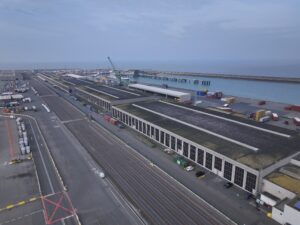
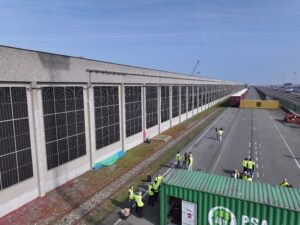
This solar energy installation is one of the largest vertical installations of solar panels in Belgium and the total annual solar power generated equals 770 MWh, enough to cover half of the entire terminal’s electricity consumption. Overall, this installation saves 101.43 tons CO2, which is equivalent to the annual CO2 emission of 220 Belgian households.
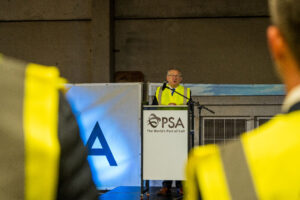
The Mayor of Bruges, Dirk De fauw, who was present at the opening ceremony, commented, “This installation shows how companies in our region are pioneering sustainable solutions. PSA Zeebrugge proves that innovation and climate ambition go hand in hand.”
“I am delighted that we are achieving our climate targets for our terminal in Zeebrugge in a creative and highly efficient way,” said Dennis Verbeeck, General Manager, Multi-purpose division of PSA Belgium. “Vertical solar panels are not common in Flanders, but we made it work as our terminal’s roof is unable to support the weight of regular solar panels.”
“While we already buy 100% renewable electricity, we are investing significantly to meet the Flemish government’s CO2 emission-reduction requirements, while contributing to PSA International’s broader ambition to achieve net zero carbon emissions from its own operations and energy use by 2050,” explained Francis De Ruytter, Regional Head Sustainability PSA Europe, Mediterranean, and the Americas. “The Flemish government requires companies with an electricity consumption of more than 1 Gigawatt-hour per year to obtain part of that energy from solar panels. With this installation, we are meeting our photovoltaic obligations for the terminal in Zeebrugge, but also for our head office in Antwerp.”
Stijn Cuppens, CEO of Insaver, added, “By installing solar panels on its site, PSA doesn’t just reduce energy costs, it also contributes to the further decarbonisation of the electrical grid. At Insaver, we believe in tailor-made solutions, tailored to the specific needs and challenges of each customer. Together with PSA, we have developed an innovative approach that perfectly matches the unique context of their terminal. We are extremely proud to have been able to realize this exceptional installation and to be responsible for its maintenance and performance as a long-term partner.”
For the Luminus Group, the PSA project represents an important step in the rollout of its “Electrify2030” program, which focuses on the electrification of the economy and society, the only way to reduce CO2 emissions and strengthen Europe’s energy independence.
Grégoire Dallemagne, CEO of Luminus Group, said, “To increase Europe’s energy independence, ensure the competitiveness of our companies, and reduce our CO2 emissions, we must focus on the electrification of our economy and society. At Luminus, we have made this our raison d’être: building a CO2-neutral energy future with electricity and innovative solutions and services. In this way, we contribute to the preservation of the planet, the well-being of people, and economic progress.”
Building a net zero carbon future
PSA is exploring further steps to source 100% of the electricity required by the Zeebrugge terminal from locally produced renewable energy. PSA Belgium’s overall objective is to halve its 2019 CO2-emission levels by 2030 and achieve net zero carbon emissions for its own activities and energy use by 2050.
With a group turnover of €60 million in 2025, of which 85% is generated in B2B, and a team of 90 permanent employees complemented by approximately 100 FTE in execution, Insaver positions itself as an industrial EPC player and full lifecycle partner (Engineer, Build, Maintain & Repower) with proven scalability.
Industrial scale as a foundation
Insaver recently delivered one of its largest integrated projects: more than 26 MWp of solar energy combined with 25 MWh of battery storage for an international logistics player.
This expertise forms the foundation for its expansion into Germany.
“North Rhine-Westphalia is a logical first step for us,” says Stijn Cuppens, CEO of Insaver. “The region combines energy-intensive industry with rising grid costs and increasing grid congestion. Companies with annual consumption above 500 MWh need integrated solutions that go beyond solar panels. We offer a total model that combines generation, storage and smart energy management.”
Focus on energy-intensive companies
In Germany, Insaver targets companies with high energy demand:
- Industry (steel, food, manufacturing)
- Logistics and distribution
- Industrial real estate
- Companies with >500 MWh annual consumption
They gain access to a complete solution:
- Large-scale solar installations
- Industrial battery storage
- Smart energy management
- Full EPC approach (from design to delivery)
- In-house engineering
- Financing solutions via specialized partners
The focus is on maximizing self-consumption, smoothing peak demand (peak shaving) and structurally reducing energy costs.
Local presence, international expertise
Insaver has already gained experience through international clients operating in Germany, including projects for companies such as Goodman and Air Products.
Further expansion is supported by a local Country Manager, combining knowledge of the German market with Belgian technical expertise.
Ambition: growth with impact
Insaver aims to achieve €15 million in revenue in Germany by 2027 and become a key player in the industrial energy market in North Rhine-Westphalia.
With one clear goal: helping companies use energy smarter, more efficiently and more sustainably.
The donation will be used by Natuurpunt Limburg to protect and restore local biodiversity. The amount is tangible proof of the positive impact that businesses and individuals together can have on our environment and nature.
“We are a voluntary organisation that protects and restores fragile and endangered nature,” explains Maïté Couvreur, coordinator of Natuurpunt Limburg. “It is important that we are supported in our objectives by companies. This amount not only allows us to support local nature projects, but is also a positive call for greater involvement.”
The presentation of the cheque to Natuurpunt Limburg took place on 26/4/2024 at the Natuurpunt Limburg visitor centre in the Kiewit area. This moment not only marks the conclusion of a successful campaign, but also provides a platform to underline the ongoing commitment to environmental conservation.
“We are incredibly proud of the results of this campaign and grateful for the enthusiastic participation of our followers,” says Jean-Philippe Janssens, general manager of Insaver. “This initiative reflects our commitment to sustainability and our belief in the power of joint efforts to preserve our beautiful planet.”
Maïté Couvreur comments, “We are tremendously grateful to Insaver for giving our organisation and the Limburg countryside such wonderful support. The donation amount is a financial boost. But more importantly, with campaigns like this one, Insaver also raises environmental awareness and consideration for nature. That awareness is absolutely necessary in this day and time, and also leads to more eco-friendly choices in daily life.”